DISCLAIMER: BOTH VIDEOS, PARTICULARLY THE SECOND ONE, CONTAIN SOME DISTRESSING IMAGES YOU MAY FIND UPSETTING. YOU HAVE BEEN WARNED, IF YOU THINK YOU MAY FIND THEM DISTRESSING, IT MIGHT BE BEST IF YOU AVOID WATCHING THEM.
Following closely on from two fatalities
in Reunion and
One of the The Chagos Islands, now
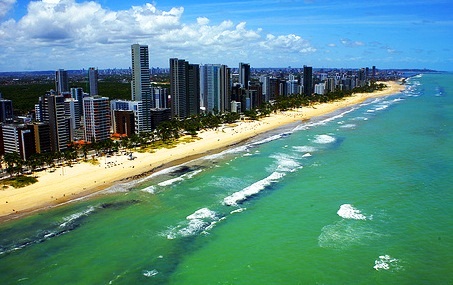
renamed Diego Garcia, an 18 year old tourist from Sao Paolo, Bruna Gobbi, has been killed in an attack at Recife, Brazil, one of the world's foremost shark attack hotspots.
What makes this incident particularly poignant is that it was caught on camera, as it unfolded, something which, despite the proliferation of technology for recording video and still imagery on everyday devices, is still an incredibly rare phenomenon, with only
the attack on Heather Boswell and the remarkable
tag team aerial assault on Shanon Ainslie, providing video of any clarity on what happens in the precise moment shark and human collide. Both these victims survived but unfortunately Ms Gobbi was not as fortunate.
Before I go any further, I want to state the obvious in that first and foremost, a young lady has lost her life in tragic and violent circumstances and the nature of the scenes captured on camera are very upsetting and although I find it a little distasteful that the aftermath was filmed in such gratuitous proximity, this video does provide a candid look at the reality of a shark attack, both the attack itself and the reaction from witnesses and lifesavers in the aftermath. Whilst I offer sincere condolences and sympathies to Ms Gobbi's family and friends, I do want to take an objective look at the incident because, as regular readers of this blog will know, this is an area in which I have particular interest.
I do also want to add that some of the comments I have seen on the articles reporting the attack have been pretty appalling, both from the moronic "kill all sharks" brigade but even more so, from supposed shark lovers, everything from claiming some kind of karmic high ground using Bruna Gobbi as a scapegoat for the Shark Fin Trade, laying the blame solely on a young girl for swimming in the sea and far too many celebratory in nature sentiments which seem to see the death of a young girl as a way to point score in favour of sharks. Please stop it, you're actually causing more harm than good to whatever imaginary pro-shark campaign you seem to think you're endorsing.
With all that in mind and looking at the video from an objective, non-emotional perspective, this is a fascinating document which presents the stark reality of a shark attack and provides valuable information to aid the assessment of the attack. That is of course, of no comfort to Bruna's family, but it's something I do want to have a look at.
Recife
Firstly, before we look at the attack itself, we have to look at Recife's unfortunate position as probably the world's most dangerous beach in respect of the danger posed to bathers and surfers (surfing has been banned since 1995) from Sharks. Since 1992, there have been 58 attacks at Recife, including the attack this week and almost half have been fatal. Only Port St Johns in South Africa has a worse fatality rate in recent times at 100%, six attacks, all fatal. The areas around Perth in Western Australia are also suffering an upturn in fatalities in recent years, providing more statistical anomalies in what is a traditionally high survival rate in global shark bite incidents.
The yearly average of
recorded attacks, bearing in mind not all attacks are reported, shows the average rate of fatalities is around 10% and most "attacks" (bites, bumps, scratches and scrapes) require relatively minor medical attention. The marked difference in the nature of the non-fatal incidents in areas like Volusia County, for example and the catastrophic injuries indicative of attacks at Recife, Port St Johns and Perth, is almost certainly down to the species responsible for those attacks and the activity of the victims, especially Recife and Port St Johns where it is primarily swimmers who are the victims.
All the attacks at Port St Johns have been carried out by Bull Sharks and barring only a handful of incidents at Recife in which Tiger Sharks were implicated, the same can be said of the species responsible in Brazil. The difference in Western Australia is the attacking species, where the Great White is responsible.
At this point, I just want to address one theory I have which could explain the increase in the rate of fatalities in WA, which is the protection of the Great White in Australian waters. Contrary to popular belief, this hasn't resulted in a population explosion, however, it has resulted in more sharks reaching the age of sexual maturity and it is far more likely that a human being will succumb to injuries inflicted by a large mature shark, than a sub-adult or juvenile. The sharks implicated in the fatalities in WA have all been very, very large and in at least three of the recent attacks, the victim has been consumed. These are
shark attacks in which predation and aggression has been the motivating factor.
As I always say in regards to shark attacks - Every incident must be assessed on its own individual merits, there is no cover all response and reasoning behind every incident in which a shark injures a human, to rely on lazy cliches, is to deliberately misinform.
In areas like Recife, there are patterns to attacks, recurring themes and elements which aid the assessment of an incident which can't be ignored and ultimately assist in increasing an understanding of risk. Recife, like Reunion and Port St Johns are relatively new areas where the risk of attack is greater than historic records suggest it used to be. For example, in the 1950's and 60's,
Amanzimtoti was the place to be if you wanted to increase your risk of attack but the last attack there was in 1984. The record books are full of locations which had a bad period of attacks which then stopped as quickly as they started and it isn't unreasonable to suggest that the same may one day be said of these three locations.
In all three places however, it is the species responsible which is undoubtedly the main causal factor in the high rates of fatality. Attacks by both Bull and Tiger Sharks are synonymous in that they are defined by the higher rate of aggression and willingness to bite the victim multiple times. The concept of the "single test bite" refers primarily to attacks on surfers by Great White Sharks, attacks on swimmers/snorkellers by Bulls and Tigers show that more often than not, the victim will face a repeated and sustained effort from the shark.
By their nature Bull Sharks are heavy set and extremely powerful, one likely reason for their physical build, is their natural diet includes other sharks so they need to be powerful enough to overpower and kill other sharks, including other Bulls. This may also suggest why they are more likely to sustain an attack over a prolonged period and attack with such aggression, if they are used to attacking other sharks, they can't risk that shark being in a position to attack them back and possibly cause an injury. What defines the attacks in Reunion, Port St Johns and Recife is this particular kind of aggression, these are by their very nature, shark attacks.
In assessing the attack on Bruna Gobbi as an individual incident, the video provides more detailed and accurate testimony than any eye witness ever could because it is not impacted by emotion or stress, instead, it documents events as they unfold.
Bruna Gobbi
So what happened in this particular attack?
We know that Bruna and her cousin, Daniele, were swimming approximately 70 yards off Boa Viagem beach and had got into trouble in a rip, Daniele later said that both were panicking, waiting for lifeguards to reach them as they feared they were going to drown.
At 0:17 in the video, we see Bruna, clearly struggling with the current, before she is pulled underwater then catapulted upwards, almost waist high from the water as the approximately 7 foot long shark, briefly visible at the surface, bites into her leg and blood clouds the water.
Two lifeguards are swimming towards Daniele who is further from shore as another lifeguard on a jet ski approaches Bruna. The jet ski is positioned between Bruna and the shark and she is hauled aboard as the other two lifeguards assist Daniele and the five head towards shore.
In the second video, it is interesting to note the relative lack of commotion, unlike in the movies, there is very little panic, instead there appears to be more an atmosphere of shock and curiosity. This is the same as my own experience having been present in the aftermath of a shark bite, during which there was an almost nonchalant and morbid excitement for want of a better phrase.
When Bruna is taken to the lifeguard hut, we can clearly see what is a large and catastrophic bite. The bone is shattered and the flesh from ankle to knee is torn completely, the poor girl's foot hanging only by the remaining skin and tissue. The severity of the wound and Bruna's dire situation are illustrated by the lack of blood on the sand and the drained, white complexion in her right leg signifying massive blood loss.
I have seen wounds like this where the victim has survived with rapid medical attention and amputation of the limb, however, bites like this are often fatal due to blood loss and shock. In comparison with many other Recife shark fatalities, this wound is less catastrophic than others but no less tragic. Sadly, Bruna Gobbi passed away after surgery to amputate her leg fifteen inches above the knee.
The footage illustrates the reality of a shark bite in that it's all over very quickly, the courage of Daniele and the lifesavers should not be underestimated as the shark remained amongst them, attempting to reach Bruna, who remains conscious throughout, as she is pulled onto the jet ski.
There is a human pre-disposition to make sense of something where there may be none, to make ourselves feel more comfortable with what we are experiencing or to justify our own opinions on how we perceive things to be. In this instance, this is not the all encompassing and highly misleading "mistaken identity" bite, nor does it appear to be a simple "test bite," looking at the video and the surrounding information, this is an exploitation of vulnerability.
There are scores of other people in the water swimming and this shark and likely several others, were probably in the area all day swimming amongst them. The trigger for this attack is most likely the rip tide which pulled Bruna and Daniele further from shore, causing them to panic, that panicking, the exaggerated and animated movement and commotion, portrayed both Daniele and Bruna as vulnerable and as such, the attacking shark, fatefully in the location in which the girls were swimming, exploited that vulnerability and attacked.
In Recife, Port St Johns and Reunion, the reason sharks have attacked people with such ferocity and unusual frequency could be as simple as the fact that sharks inhabit these areas, people swim in these areas and every now and again, a shark is compelled to approach a swimmer or surfer with aggressive intent. Using the water in these areas brings with it an inherent risk, albeit a small one, of shark attack, that doesn't mean the victims are automatically at fault as a few too many people seem to relish claiming, it is just a small part of life in these areas.
So what is it that makes these beaches so dangerous?
Recife used to have a busy industrial slaughter house pumping waste into the river system which would work its way in to the ocean, the currents would then disperse this effluent and bovine bodily fluid along the popular tourist beaches so surely it must be that to blame, right? Well, no, not necessarily and it's far too simplistic to suggest that the presence of slaughter houses, canning factories, fisheries waste plants etc are directly causing fatal shark attacks.
The Slaughterhouse has since been shut down, in I believe, the mid 00's but the sharks are still very much present and unfortunately still occasionally seriously injure people.
The near shore coastline of Recife, in particular the areas around Boa Viagem and Piedade where more than three quarters of incidents have occurred, is characterised by a deep channel running alongside a sizable reef which acts as a natural barrier between beach and open ocean, save for a break in the reef which opens the access to the near shore bathing area to that deep channel but then, this has been the case for millions of years, Recife has been a hugely popular beach for decades, yet prior to 1990, attacks here were exceptionally rare, some reports suggest non-existent.
Opening out into Recife's coastline is the Jaboatão River, a characteristic element of Recife's landscape and it is here where we must also look for possible answers. In 1978, industrial development and construction began in and around the natural port of Saupe which impacted the landscape to the point where the mouths of the Merepe and Ipojuca Rivers, areas rich with mangrove plantations and biodiversity, were filled in as part of the industrial development. This, according to local scientist, Fabio Hazin, displaced the population of Bull Sharks using the rivers to give birth and the juvenile sharks using the rivers as a nursery, to the Jaboatão River, which runs directly out to the beaches so popular with bathers.
The development of the port also meant more shipping traffic, meaning more shipping waste and potential for more sharks accompanying these ships closer to shore, added to that, 59% of the Saupe Port complex, roughly 7500 hectares, is devoted to environmental protection, providing areas of protection for temporary and resident marine life.
Recife is an attractive location to Bull Sharks, both naturally and through man made impact, it has river nurseries, deep channels, areas of relative health and biodiversity and the attractant of increased shipping traffic waste. That aligned with high numbers of annual visitors, means that there will be times when sharks and humans collide.
For whatever reason, or culmination of reasons, Recife is a potentially dangerous place to use the ocean. It is often the case in locations where multiple attacks have occurred, that various elements combine to increase the frequency of large, predatory sharks in areas used by people and dependent upon the species of shark, the rate of attack and ultimately, the rate of fatalities, will be affected exponentially.
How can we prevent these attacks?
The simple answer is that, short of staying on the beach and out of the water, we can't, it is misguided of anyone to think they have the answer or the "preventative measures" to stop the attacks in Reunion, Recife and Port St Johns completely. Historically, the two main measures put in place have been shark nets and culls and neither are 100% effective and are even less environmentally justifiable.
You cannot prevent shark attacks in places like these, we can only do what we can to reduce the risks but sometimes, the only option outside completely banning swimming (which people will ignore anyway) is to accept that shark attacks will occasionally happen and that we are prepared for the times they do with effective medical emergency procedures, to try and reduce the number of fatalities.
There is no particular science behind shark attacks, there are just too many factors to take into account in a phenomenon which is so small scale and in which so much varies. Species, location, conditions, activity, the victim themselves, access to medical assistance, all of these affect why a shark attacks, how a shark attacks and what level of injury the victim sustains. In Recife, it is swimmers who are primarily targeted and without the barrier and potential respite of a surfboard, they are more vulnerable to repeated injurious bites and it is also harder to exit the water. The attacking sharks are almost always Bulls, meaning higher risk of multiple bites and multiple bites mean higher risk of mortality. The factors affecting the rate of attacks in Recife is different to those in Western Australia, Reunion etc so, like I said, we have to treat each attack on its own merits and in doing so, appreciate that the prevention of something with so many variables is practically impossible.
To describe these kinds of incidents as "mistakes" and "accidents" is not only factually incorrect but it also promotes the acceptance of myths as truth, much like the concept of the shark as a cold, calculating killer with a lust for human flesh. Perpetuating the fallacies and falsehoods of shark attacks is harmful in that it pushes us further away from the proper understanding needed to establish ways in which we can make our use of the ocean as safe as possible both for us and the sharks.
I am incredibly fond of Bull Sharks, yes they are potentially extremely dangerous but simply thinking of them in terms of the danger they pose to humans is to do a great disservice to their intelligence, charisma, beauty and importance, they are such a cool animal and are not the bloodthirsty killers portrayed by the media as made clear in "Of Shark and Man," if you watch the teaser trailer below, do these sharks look like the indiscriminate killers they're made out to be?
We can only hope incidents like the recent fatalities remain infrequent but one element in all of this which we can control, is how we react, sharks aren't malevolent anti-human killing machines and nor are they carrying out some kind of environmental vengeance against humans so we need to stop reacting as though they are, let's not let agendas cloud how we publicly react to something as tragic as the death of an innocent teenager.