Rusi doing what Rusi does (Fiji) - Photo: David Diley
Yes, we've done this before, I know, but a proper, intelligent discussion about shark feeding is something I am always interested to be a part of and also because it never ceases to amaze me that many of the myths and untruths surrounding it, continue to be perpetuated, usually in social media circles but more worryingly, occasionally in the wider media spectrum. Let's not forget, it wasn't long ago that a group of Hawaiians took to burning boats, so outraged were they by the frenzy stirred up in the media.
A big part of "Of Shark and Man" is that I am telling the full story about Shark Reef in Fiji, and I mean the full story, all the nuts and bolts, the protocols, the environmental benefits, the economic benefits, the sharks, the people and everything in between. This cannot be done without addressing the issue and controversy surrounding Shark Feeding and in the last few weeks, I have spent a large amount of my time putting together a section in the film dedicated to that controversy, so much so that I would speculate that at 24 minutes, it might be the most in-depth look at the subject, on film, in existence.
Part of that is presenting both sides of the argument and I was hugely fortunate to get the opportunity to get the Anti-Feeding side from the impressive, articulate and well respected Helen Sykes of CORAL, who spoke eloquently, from a position of shark welfare and conservation. I could go to social media and collect this argument from the rabid hordes of people with loud voices and angry opinions, but in an intelligent debate, that helps nobody. Helen and I disagree on certain things, but I respect Helen enormously and she makes a fantastic contribution to the piece in the film.
Whilst working on this portion of the film, I came across a discussion about shark feeding consisting a wild statement and a couple of replies. Despite knowing better, I took the bait and the discussion exploded into a contentious debate with some interesting points being made by both sides, before, as is always the case with social media debates, it descended into name calling and toys going out of the pram, so I figured, I'll address it here and encourage you to get involved in the debate here (more on that in a bit.)
Anti-Shark Feeding protest (Hawaii)
To do this properly, I need to address both sides fairly. This is primarily an opinion piece so I am not telling you what to think, however, my opinions have been formed through my own personal experience and research, the research and experience of others more experienced than I and also through dissecting the issues at hand from a neutral perspective. I have no vested interest in shark feeding, my motivation is the welfare of sharks, full stop. I do not financially benefit from shark feeding and I am comfortable with scientific advice and more importantly, the findings of people who have extensive personal experience with shark feeds and the ancillary effects of their existence, both positive and negative.
You are not being told to believe what is right and wrong, you're getting a detailed dissection of the issue and are being invited to make up your own mind. I believe I have a degree of credibility on this issue, but there are those out there with far greater credibility than I, if you think that's you, you are invited to join the discussion where you will be warmly welcomed.
Before I begin, I want to clarify a few things first so as to quantify from where I and others, are coming, in respect of this discussion. This is not an angry outburst or a group of wild, ill considered statements and this is especially not a discussion borne of intolerance, if you want that, spend the day on Facebook or read The Daily Mail.
Before I start, let me clarify that I am fully aware that not every shark feed is run responsibly and not every shark feed uses protocols that I would consider suitable or conducive to a safe diver/shark experience. No shark feed is 100% safe, simply involving SCUBA diving ensures that.
Here goes:
- Conservation is an integral part of this discussion so be aware that conservation in the 21st century is not merely an environmental issue, more and more, conservation has become an issue of economics
- "Shark Feeding" as discussed here, is what I would classify as an operation which specialises in offering paying customers a chance to take part as spectators, in an organised dive based around a professional feeding sharks as part of a spectacle for said customers. These shark feeds will be a regularly repeated operation using the same protocols on each dive, those protocols being specific to each operation. Some good, some undoubtedly bad.
- The examples I use are examples about which I know and/or have experienced personally, please don't get upset if you have had a different experience on a feed not referenced here, that's not my fault.
- I have no agenda for or against anyone or anything referenced here, if you are referenced and you don't like what you read, please get in touch in the comments where you will be warmly welcomed to discuss further without fear of being called names or condescended to. I respect anyone who wants to be a part of an open discussion.
- My own experience comprises about 150-160 dives with sharks of various species in various locations, many have been baited dives, some have been the rigidly organised, beginner type dives (Stuart Coves Caribbean Reef Shark Feeds for example) and others have been more what can be called "proper shark diving" adventures from which I learnt more about sharks than I ever could as part of a larger group.
- I would say my main areas of interest and knowledge regarding sharks would be shark attack and shark behaviour, both of which make up a large part of the shark feeding debate so I would say I'm pretty well placed to discuss it but I am not a scientist and nor do I undertake any scientific research personally. I will defer to the expertise of others in this piece and the people to whom I defer will be those with the experience I don't have and those with that scientific base of research.

Photo by Matthew Meier
To begin with I want to look at the arguments against feeding sharks as part of a commercial operation. These arguments primarily centre around the following:
- The risk of shark attack to people on the dives but primarily, the risk posed to bathers, surfers and divers using areas in close proximity to feeding areas
- The ecological effects on sharks and natural shark behaviour
- The ethics of humans feeding wildlife
- The use of wildlife conditioning for the financial benefit of commercial dive operations.
- The conditioning of sharks to humans as a provider food
- Aggregating sharks in ares where they may become vulnerable to fishing fleets
Shark Feeding and Shark Attack
Shark feeding as a source of generating commercial income began on a wide scale in the mid-nineties and shark attacks have been happening ever since man first started using the ocean as a source of subsistence and recreation.
According to the International Shark Attack File there have been 2,569 "unprovoked" shark attacks worldwide between 1580 to 2012. I am using the ISAF as the source here for the only reason that it is currently the only extensive source of data for shark attacks available. In my opinion, the ISAF is not 100% accurate primarily for its classification of what constitutes "unprovoked." There are omissions from their records which I feel are not reflective of the true data, however, for the most part, it is a valid source of statistics for this particular discussion.
Shark feeding operations started to become truly widespread around the globe at the turn of the 21st century. According to a 2012 study by the University of British Columbia, there are seventy dedicated "Shark Watching Sites" in forty-five different countries, classified as locations where dedicated baited and non-baited shark encounters occur.
The results from this study show that an accurate estimate would suggest over 590,000 people, each year take part in a shark watching experience. Most of these will be as a diver or snorkeler thus meaning, over half a million people knowingly enter the water with sharks each year, around the world. Of course, not all these operations bait the dives. This study would confirm of what we have all been aware for some time, that more people than ever are encountering sharks in their natural environment and that number is also steadily increasing.
Between 2001 and 2012 there were 812 "unprovoked" attacks around the world, with Florida, Australia and Hawaii providing most of the victims. This league table reads as following:
1. Florida
2. Australia
3. Hawaii
4. South Africa
5. California
6. South Carolina
7. North Carolina
8. Brazil
9. The Bahamas
As a caveat, I will add that Fiji had 11 attacks in that same time period.
During that period and in one of those locations, there was a fatality during a baited shark dive, when Markus Groh was bitten by a Bull Shark (although reports vary on the species responsible) during a feed in The Bahamas. It is not my place to give a definitive account of what actually happened that day as wasn't there and do not want to speculate, however, this remains the only occasion whereby a spectator on a shark feed has sustained serious (in this case fatal) injury.
The popular argument is less about the safety of participants on these dives and more about the risk to recreational water users in areas close to those used for shark feeding. Looking at the list above, we need to link those attacks to shark feeding to give this argument any credibility, or of course, provide proof of a lack of any connection:
Florida - Shark feeding is banned and there are currently no shark feeding dives operating within federal waters
Australia - Shark feeding operations are surprisingly sparse with those that do operate, primarily being the Great White cage dives in South Australia and the shark rodeo dives in the North East. Western Australia, particularly around the Perth area and South West which is currently experiencing an unusual spike in incidents, has no shark feed operations.
Hawaii - Shark feeding is banned. There are no longer shark feeds in operation here.
South Africa - A shark diving hot spot with several baited cage dive operations in the Cape Town area and baited open water dives off the Durban coast.
California, South Carolina, North Carolina and Brazil - There are no recognised, dedicated shark feeds in any of these areas.
The Bahamas - The shark feeding capital of the world where shark feeding is a major source of tourism.
Fiji - Fiji has two main shark feeds on the same area, a mile apart. None of the eleven attacks occurred in areas within close proximity to this area.
In this time period, shark attacks have remained at a consistent average yearly rate in California and both South and North Carolina. Brazil, the Bahamas and Florida are seeing a slight decline in attacks and South Africa, Australia and Hawaii are experiencing a minor increase although in Hawaii, the jump from three attacks to ten in the space of twelve months is unusual in itself but it is not unusual that locations with historical records of annual shark attacks see brief periods with statistical anomalies where attacks spike in excess of what would be considered "average."
The global trend shows a decrease in annual attacks in the first half of this period followed by an increase in the second half.
Where we need to look for proof that shark feeding increases the risk of attack is in the areas where shark feeding is widely practised, the three prime examples being South Africa, The Bahamas and Fiji. Where South Africa has seen a slight increase in attacks, primarily as a result of a spike in 2010 which would qualify as one of the aforementioned statistical anomalies, the increase is in no way reflective of an increase in perceived danger posed by shark feeding as these attacks did not occur in a proximity anywhere near close enough to locations used by shark feed operations. The Bahamas has actually seen a decrease in the attack rate and attacks in Fiji remain consistently rare.
There has now been well over a decade for the argument that shark feeding increases the risk of attack to be proven but the simple fact, that sharks will pose a greater threat to humans because of shark feeding, has widely been discredited, the stats just don't add up. By that argument, The Bahamas and Fiji should be the two most dangerous parts of the world to use the ocean, when in reality, of the global areas where shark attack can be conceivably argued as a "natural risk," both The Bahamas and Fiji, where large, potentially dangerous sharks are relatively plentiful, are statistically the two areas you are least likely to be attacked.
We must also balance out the argument by recognising that both Mexico and Cuba, where shark feeds are undertaken have experienced a slight increase in shark bites on swimmers in the last two years but this cannot be reliably linked to those feeds unless this continues at the same rate for the next few years which is extremely unlikely. Russia, Vietnam and Egypt have also seen spikes in shark bite but none of those countries have organised baited shark diving operations.
So, statistically speaking, you are less likely to be bitten by a shark in areas where shark feeds occur, a fact which on its own completely discredits the notion it poses an increased risk to ocean users. The rate of global shark attacks has not been affected by shark feeding, the stats are there for everyone to see.
In the simplest way of looking at it, there is absolutely no evidence or proof to claim that shark feeds increase the risk of attack, whereas there is statistical and anecdotal evidence which does in fact suggest the opposite.

Martin Graf - Wow!
Feeding sharks will weaken their natural predatory instincts
This argument is based on the assumption that if you feed sharks enough, they'll stop hunting in their natural way and that migratory sharks will instead, maintain an unnatural site fidelity.
In Fiji, Beqa Adventure Divers operates an active daily research data process on each shark feed, during which individual sharks are recorded as present on each dive. This is primarily in regards to the Bulls as the dominant species and is essentially, a register, like you had at school, to maintain and update a log of all the sharks that appear on the dive.
The feeds take place five days a week and up to one ton of food is introduced into the process every week. That's a lot of Tuna heads!
There are around 150 individual Bull Sharks which have been recorded on Shark Reef at this site since 2002. A small number of these individuals could be classified as "resident" in that they spend most of the year on or around Shark Reef but the majority are transient. Bull Sharks are by nature, wide roaming and the individuals which do not fall into the local population will visit the feed sporadically over the year, most return, others do not. The returning animals will stay, on average between 2-10 days (Mike, correction if required) and the data suggests that many of these individuals appear at roughly the same time, in cycles of around ten days, before disappearing again.
As part of my filming "Of Shark and Man" I tested whether the sharks would still aggregate on non-feed dives, carrying out a number of dives in the arena on Shark Reef on the "off days" during which only 6-10 individuals were present, never approaching closer than ten feet and in no way displaying any aggression.
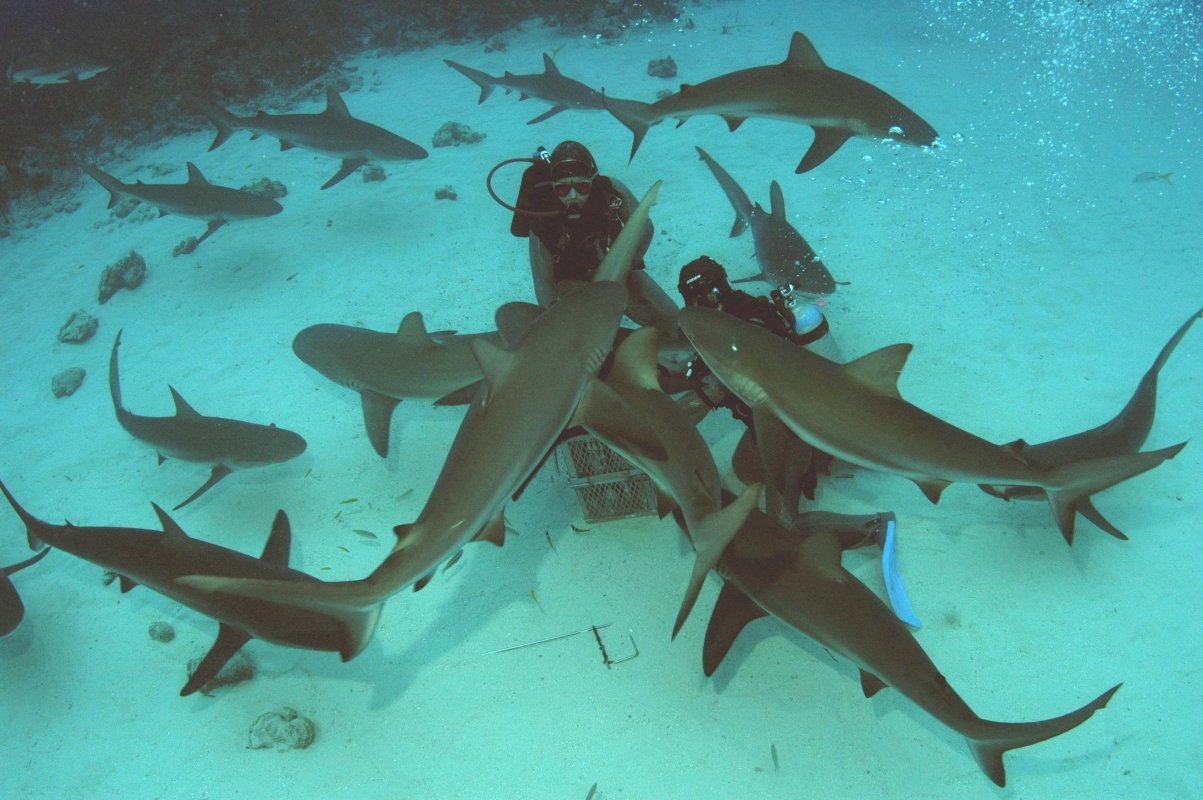
During feeds where up to 100 individuals are present, only between 5-10 individuals actually feed, the others preferring to seemingly be part of what is something of a social gathering, observing the action in varying degrees of proximity. This feed uses Tuna Heads which have an extremely low calorific value, being that they are made up of mainly bone, ensuring the shark's natural hunger is in no way affected by their intake of between one and three heads per dive. Over the course of a week, different individuals will feed meaning a single shark may only take one head during an average ten day visit to the feeds. Most sharks will spend their time on the feeds without actually feeding before again disappearing.
This paper by Juerg Brunnschweiler dissects this particular area of research in detail and is well worth a read. This from the conclusions:
In conclusion, our results and the still few studies that looked at the behavioural response of sharks to food provisioning all indicate that residency patterns and site fidelity to long-term shark provisioning sites are species specific and that intraspecific variation exists. Furthermore, evidence is accumulating that chumming and food provisioning are unlikely to fundamentally change movement patterns at large spatial and temporal scales, and seem to only have a minor impact on the behaviour of large predatory sharks [14], [16], [44]; hence, the creation of behavioural effects at the ecosystem level seems unlikely [44]. It is further worth noting that sharks that were both visually observed and tagged in this study were individuals that have a higher propensity for showing behavioural responses to provisioning. We found that C. leucas do not appear to be strongly conditioned to the provisioning tourism and also exhibited diver avoidance. However, the sharks monitored in this study are biased to being individuals ‘more likely’ or ‘more comfortable’ to be observed or tagged. Thus, it stands to reason that the overall impacts of provisioning tourism on the C. leucas population as a whole is even less.
Not all operators undertake this kind of rigorous data collection and research but if we look at many other feeds, the suggestion that sharks natural predatory instinct and migratory behaviour can be viewed as incorrect by the very fact that those operations exploit natural seasonal aggregations of target species. Bull Sharks in Playa Del Carmen appear on the feeds periodically between December and March, Great Hammerheads in the Bahamas between January and March, Great Whites in Guadelupe between August and November and so on. There are feeds which take place in the tropics, including in The Bahamas which centre around resident Reef Shark species which exhibit naturally high site fidelity meaning the behavioural effect on those animals in regards to migratory patterns is negligible to non-existent.
Barry Bruce and Russel Bradford undertook a study in the Neptune Islands, South Australia to investigate the effects of chumming for sharks by cage dive operators, it's a big one but again, from the conclusions;
"As seen in previous research, white sharks tagged during the study were found to be temporary residents of the Neptune Islands. Despite berleying, sharks continue to arrive and leave the Neptune Islands. As in previous years, the number of sharks present at any one time was highly variable.There were some periods when no sharks were present.These patterns are probably driven by differences in the ocean conditions between years and seasons.
Increased berleying has not led to sharks taking up patterns of permanent residency and sharks left the Neptunes Group for other destinations across their Australian range during the study period. For example, three tagged sharks were detected by acoustic receivers moving through south-western Western Australia after leaving the Neptune Islands during the course of the study."
Research and current data points heavily to sharks maintaining natural predatory and site fidelity behaviours in and around areas where shark feeds take place. There is no data that I am aware of which would suggest this is not the case so it would appear again, that this concern, whilst valid, is not applicable as a reason not to feed sharks in organised shark feeds.

It is ethically and/or morally wrong to feed wildlife
Point one, assigning the ethics of human/wildlife interaction as a cover all set of rules for all wildlife is not only wildly misleading, it's also pointless. "Bears do this, lions do that, Ospreys do those..." etc etc ad nauseum is not a valid argument when discussing sharks. If it were, we would believe in "Rogue Sharks" because crocs, lions and tigers occasionally go rogue, it's a proven fact, that there is ZERO evidence to reliably confirm the existence of "Rogue Sharks" is also proven.
Point two, morality and a code of ethics is a personal thing, what you consider morally abhorrent may be seen as perfectly acceptable in other cultures and vice versa, your morality and ethical viewpoint is not fact, it's a belief system.
There are people who believe feeding sharks is ethically wrong and that is of course, their right, however, this is not and never will be, a point by which something should be proven right or wrong. I don't like scripted reality shows so I don't watch them, other people do so I don't demand they be taken from our screens. Demanding something be banned because you don't like it is extremism, it is oppressive and in itself, is in my code of ethics, morally wrong. If you think something should be banned purely based on the fact you don't like it, then you are not approaching the issue at hand from anywhere verging on being in the same post code as an intelligent or informed place.
If you don't like something, don't do it, if you are concerned about the wider reaching effects of something then you absolutely must inform yourself with information from both sides of the argument before even beginning to consider requesting something be altered, ceased or legally outlawed.
The majority of arguments for and against shark feeding come from a place where people are speaking on behalf of sharks and the uncomfortable truth we have to address is that the vast majority of these people are not qualified to do so with the authority that is required to address the issue properly and as such, with anything, we must always defer to what is proven to be or not to be or at least, look at the evidence ourselves and know what it is we are looking for. It is not the fault of the layman for being a layman on many important issues, it's not a weakness or a criticism, it is what it is. There are always people out there who know more than you or I on a whole host of things so it is for us to question what we see (including this very blog) and to inform ourselves as much as possible.
Your code of ethics is not sufficient to demand anything when not aligned with material to validate why you feel the way you do.

Photo: George Konig
Conditioning animals is bad, conditioning animals for money is really bad
Two forms of conditioning take place on shark dives, the conditioning of the sharks to the process of the feed and the conditioning of divers to sharks. I believe the latter is the more dangerous (more on that in a minute...)
Using the Beqa Adventure Divers Shark Reef feed as an example again, the protocols are extremely strict, as they themselves will tell you, this is not the dive if you want to improvise, you do as you're told, if you don't, your dive is over.
That approach extends to the sharks. The dives occur at the same times on the same days in exactly the same ways, at the same depths, with the same crew and protocols without exception. The sharks there have been conditioned, they are in fact, the most conditioned Bull Sharks on the planet. With that in mind, in answer to the question, "do shark feeds condition sharks?" the answer is yes, they do.
In Fiji, with B.A.D, the Bull Sharks are quickly conditioned, showing a level of intelligence which may surprise you, that they will only get food if they approach from left to right and that they will only be fed if they behave appropriately, any aggression or if things get a little too hot, the box is closed and the feed is over until, if at all, it can be recommenced when they have settled down. The sharks have also learnt that the wall where the spectators are placed, is a no go area, forming what seems like an invisible barrier the sharks do not cross while the feed is under way. When the feed is over, the sharks remain in situ, before dispersing.
This is undoubtedly conditioned behaviour and similar procedures are evident around the world so ask yourself this question, is this conditioning a bad thing? The only real answer is, "it depends."
The Bull Sharks in Fiji are displaying behaviours conclusive with being at least partially habituated to humans, the same applies at many other shark feed sites. This habituation however does not seem to equate with aggression as implied in my earlier experience with the sharks there and at other feed sites around the world, the habituation seemingly applies primarily during the feed and on non-feed days, in my experience, manifests itself as indifference to human presence. They would seemingly appear less cautious of humans which in itself raises questions about their welfare and vulnerability to "non-friendly" humans but I will address that in more detail later, what I am sure of though, is that in my experience and the experiences of others I have spoken with, this habituation is not linked to aggression.
Where conditioning of sharks can be problematic is when multiple operators utilise the same site with different protocols, for example, one operation hand feeds, another uses chumsicles and another dump feeds. The benefit of hand feeding is that it is more selective, the opposite end of the spectrum is the more random elements of dump feeding which makes a feed harder to control. I have heard reports that these variances in feeding techniques have been causing some concerning changes at one particular site in The Bahamas, where the different feeding protocols is creating confusion amongst the animals with several large individuals becoming "beggar sharks," sharks which are behaving as they would on a dump feed, during the more controlled process of piecemeal feeding. This isn't proof that shark feeding is bad but it is proof that stricter control of protocols is needed to ensure the site remains as safe as possible and this is the sole responsibility of the operators to work together, realising that ensuring safety, equates to ensuring longevity at the site as far as opening dives to the paying public is concerned.
The golden rule of shark diving is to stack the odds in your favour, by creating confusion amongst the animals, you are losing the ability to do that and that's when things get dangerous.
As for the exploitation of wildlife to make money being bad, again, that's a case of one's own moral code deciding how you feel. Some shark feeds make a lot of money, how much of that they put back into the welfare of animals is up to them but I would personally like to see all shark feeds ploughing money into the protection of the animals from which they earn a living. Many feeds ensure financial input into shark welfare, some don't but we live in a world unfortunately ruled by capitalism and if your moral code causes questions in your own mind, choose an operation which actively promotes shark welfare or don't take part in shark feeds. If you really have an aversion to the exploitation of the natural world for money, I would suggest sitting down and making a list of products and services you yourself use that don't impact the natural world and only use those entirely. That would, I assume, lead to a dramatic change in lifestyle for all of us.
What I feel is more dangerous is conditioning humans to sharks, by that I mean humans believing that, after emerging from a shark dive unscathed, that sharks are not potentially dangerous or even worse, that they now somehow possess the ability or even the right, to manhandle sharks, to ride sharks and to dive way beyond their capabilities. Sharks deserve, nay demand, respect, if we teach divers that sharks are benign creatures who just want to be friends, we are creating people who are severely misinformed and giving them a carte blanche to behave irresponsibly with animals which could easily inflict fatal injury.
Any shark dive should, in my opinion, impress upon all their clients the importance of "look don't touch" and instill at least a modicum of educational content in their briefings.

Shark Feeds aggregate sharks in areas where they are vulnerable to fishing
So far, my argument has been heavily weighted towards disproving many of the anti-shark feeding issues but this one is more difficult. The simple fact is if you spend enough time creating an area where sharks will visit or in some cases live full time, it will become an attractive place for fishermen to go and catch sharks. Playa Del Carmen is a prime example and this argument, above and beyond all others, is the one which must be addressed by anyone looking to open a shark feed site. If your opening a shark feed is going to aggregate sharks to an area where they can be wiped out by as few as a single fisherman, then don't do it, it's not worth it.
If there is one operational lesson that all shark feeds should learn, it is that which makes Shark Reef so special, first of all, protect the area. If you can show that a shark feed can create jobs and financial incentives to a local community and it would provide an improvement in the lives of the people in the area, then you must also caveat that with the importance of longevity. The longevity of that economic boost to your community is directly affected by the continued presence of sharks, no sharks, no dives, no money.
Without exception, protect your site, if you don't, you're asking for trouble.
Now let's look at some of the arguments in favour of shark feeding. At this stage I want to again qualify, that the pro-feeding arguments I present from my own viewpoint are based on environmentally sound, ethically handled (by my own code of ethics of course), responsibly run and strictly controlled shark feeds. I acknowledge that this does not apply to every shark feed in existence.
This in itself can be applied to the entire SCUBA Diving industry, some do it better than others, you will have experienced this yourself, poor underwater practise and procedure is not limited to shark eco-tourism.
The main arguments in favour of shark feeding and baited shark dives can be listed as the following;
- Economic influx to often third world countries and the emergence of career opportunities
- The reliance on healthy shark populations
- The environmental benefit from healthy shark populations
- The creation of passionate new shark lovers
- The economic initiative to governments to protect sharks to maintain and develop tourism
- Ancillary financial benefit to other businesses in the community

Shark diving and Shark Feeds create economic growth in third world countries
Poverty is an uncomfortable truth in modern society, I read a statistic a while back stating if you earn £14,500 per year, the average wage of a call centre worker or McDonalds employee, then you are amongst the top 5% of the world's richest people.
Read that again. Now read it again and let that sink in.
Shark conservation, in fact almost all wildlife conservation is now less an environmental issue and more one of economics. Capitalism ensures that we as a society value only that which carries a financial incentive. The governments of the world will, on the whole, rarely do something because it is the right thing to do, they will do it if it pays.
Some of the best places in the world to encounter sharks are third world countries where many of the indigenous people live in wretched poverty, we visit these places, we buy our souvenirs and wax lyrical about how wonderful and warm these people are and then leave, back home to our comfortable lives and well paid jobs (yeah, even those who work part time in Topshop, read the above stat again) whilst they remain in poverty.
Many of these third world countries rely on tourism and dive tourism is a major source of income. Diving is expensive, we have money and we spend it in their country, directly in the services and products we pay for and indirectly, in the jobs that it creates in resorts and local businesses.
Using the study by The University of British Columbia again, every year, shark tourism generates over US$314,000,000, that's three hundred and fourteen million dollars, every year from sharks, supporting more than 10,000 jobs within the industry. Of course not all of those are baited shark dives but without this industry we see 10,000 jobs gone and exactly $0 of that income in circulation.
This money means careers, it means training opportunities, it means financial freedom for the employees and their families, all of which then gets circulated through the local economy as those employees and business owners pay for products and services themselves. For the businesses which pay tax, that tax then improves local infrastructure, schooling and education, public safety and communal utilities and hygiene, all of which is reliant on the shark dives. If these dives were to cease, the reality is that there are areas which would suffer enormously, potentially seeing a whole local industry collapse, in many other places, tourism would still occur but the money that is no longer in circulation is now no longer being spent in or on the local community.
The feed at Shark Reef ensures the survival of the village which owns the reef, provides full time employment to members of its youth and pays for the materials to build homes, village halls and areas in which they can grow crops. Every diver pays a levy of F$20 per dive that goes directly back to the village and has, since 2006 raised more than F$160,000 in direct income for the upkeep of the village. The Feeders and Dive Masters are also paid extremely well and rewarded for performance, contrary to the general pay scheme in the dive world, where passion for the sport is exploited with often pathetic salaries. At Beqa Adventure Divers, the senior guys earn more than a lecturer at Suva University and the money paid to employees supports whole families through their schooling and care.
During a discussion this weekend, one individual was adamant that shark feeds "should be banned" stating along the lines that they "don't give two hoots about the humans involved," but I would wager should that individual visit a village like Galoa, in a developing third world country they wouldn't be so ardent in their claim they would happily see them no longer receive the financial assistance the Shark Dive offers them, I would like to think instead, they would feel a sense of humility whilst experiencing hospitality afforded to them by people who know more about the impact of shark feeding than most people ever could.
The financial incentives to support shark eco-tourism including baited shark dives aren't only limited to the operations and their employees. Ancillary financial benefit is also enormous, by ancillary I am referring to money that circulates through an economy which has been generated by people visiting a particular business, whilst spending money in other parts of the community as part of their stay.
An example, I visited The Bahamas in 2008 purely to dive with the sharks, the sharks were my reason for going and whereas the operator made money from my visit, so did the following:
Airline
Airport Shops
Taxis
Restaurants
Bars
Souvenir Shops
B&B
Supermarket
Every year, The Bahamas alone generates approximately $78million in direct and ancillary income linked to the baited shark dives.
This is intrinsically linked to the following point...

Shark Diving directly influences Shark Conservation
It does, that is an absolute nailed on, stonewall fact.
The Bahamas is a shark sanctuary because of its shark dive industry and the Shark Reef Marine Reserve exists because of the shark feed.
Marine Reserves and Shark Sanctuaries can of course exist without shark diving, but in areas where shark feeds are present and generating sustainable economic contributions to the community, the likelihood those habitats can be protected is far greater. As I said earlier, conservation is a social issue and one of economics, if it pays it stays. Shark feeds rely on healthy shark populations, if you allow the eradication of that shark population you lose the long term money and the fear of that is helping to drive conservation initiatives.
Most of the readers of this blog will be all too aware that a live shark is worth far more than a dead shark and if that value is apparent in third world countries, then it means the fight to protect the world's sharks swings further to the side of conservation because it makes it more difficult for the Shark Fin industry to exploit the poor because that's what they do, they exploit the poor.
There are stories of Shark Fin traders exploiting the Fijian sugar shortage, encouraging islanders to fish out their sharks in return for sugar, other pacific islanders are given tobacco, in the Marshall Islands, before the sanctuary, a kilo of shark fins would make the fishermen $2.50. Whilst these Pacific islanders were given sugar, tobacco or loose change, these fins were changing hands in Asia for up to $900 per kilo.
If there is no financial incentive to protect sharks in developing nations, the alternative is shark fishing, more often than not, to provide fins. The encouragement comes from incredibly wealthy companies, paying next to nothing to fishermen to potentially destroy local eco-systems upon which they may have relied for centuries. The sharks are gone, the eco-system goes to shit and the Asian traders disappear with pockets full of money, leaving them with nothing.
If shark dive operators protect the areas they utilise, it means the sharks thrive, their business thrives and it can continue to make money for the local economy. It's basic economics, a live shark can be "used" again and again and again, a dead shark can be used only once.

Photo: Mike Neumann
I've seen it myself, two friends accompanied me to The Bahamas, neither was massively keen on encountering sharks but with a little cajoling into joining me on a shark feed, at the end of the week, both are now passionate shark lovers.
Seeing an animal as awe inspiring as a shark in the flesh is a life changing event, I don't know of anyone who has done a shark dive and surfaced with an opinion of the animal which has been negatively influenced from that they had before the dive. Shark feeds can also encourage educational possibilities, not just that, the level of inspiration gained from the privilege of seeing these incredible animals up close creates a bond in the diver to the sharks and unquestionably instills a passionate sense of the value these animals provide in the natural world.
To ensure these animals are present on these dives, often means baiting so can it not be argued, that baiting dives is a small price to pay for all the good it does for shark conservation?

Sharks ensure, promote and maintain health on coral reefs
Many species of shark play a role as Apex Predator on reef systems around the world. It's a widely renowned fact that sharks are the guardians of many healthy marine environments, balancing the food web, controlling the populations of predators and eradicating the sick, weak and dying. The effect of this is felt at the very base of these food webs and carries all the way to the sharks themselves at the top.
Again, I will refer to the story of Shark Reef, where a reef devoid of life, destroyed by industrialised fishing and unsustainable practise, was brought back to life as a direct result of baiting the area to feed sharks. Now, a little over a decade later, almost 500 species of fish, including eight shark species, thrive, including, contrary to concerns raised by Marine Biologists, herbivorous species. Each marine species on Shark Reef, from the tiny to the huge, benefits from the wealth of life present and that all relates back to the sharks, sharks which were attracted back to the area by introducing food into the reef, purposefully to create a sustainable shark dive.
It's not just the fish that benefit either, if an area is protected as part of a shark dive, it creates refuge and allows fish to reach sexual maturity and breed, that means more fish swimming around the boundaries of protected areas, spilling out into non-protected areas where local fishermen are now catching more than they ever have done. Shark Reef has not only provided sanctuary, it has provided a sustainable source of food to Islanders who rely on subsistence fishing.
If you create a protected habitat where sharks are allowed to thrive, you are by proxy, creating a habitat where, nature is allowed to do what nature does. The fear that overloading an area with sharks will effect resident fish species would seemingly be one which hasn't transpired, I am not aware of a location where this is the case however, I am happy to be proven wrong.
Other benefits can even be seen in ways that human interference has put eco-systems at risk, for example, the explosion of non-indigenous Lionfish in the Caribbean where sharks are doing their bit to help fix a man-made problem.

Photo: Jim Abernethy
Conclusion
This piece isn't designed to convince the non-believers to join the church of shark feeding, nor is it claiming to be the definitive argument on the issue, it's a discussion piece where I have in places, given my opinion and in other places provided some facts and where possible, some balance to the debate.
There are a lot of myths surrounding shark feeding and a lot of loud voices shouting things which do nothing of any benefit on a wider scale where shark welfare is concerned. Some of you may agree with all the above, some may agree with none and others in between, as such, you are invited to discuss the issues raised and those which maybe aren't present, in the comments section below. A few rules though, as the benevolent dictator of this blog I make the rules, no name calling and no tantrums not only that but please, put ownership on your comments, include your name! Everyone will be given the respect to air their views how they see fit, be warned, people might disagree so if your natural reaction to that is mud slinging and tantrums, this isn't the discussion for you.
So, to conclude, I will nail my flag to the mast:
I wholeheartedly support responsibly run, environmentally sound and strictly controlled baited shark diving which supports the welfare of the sharks it utilises and the people in the local and nearby communities. I am a staunch believer that shark eco-tourism, both baited and non-baited, is the best chance sharks have for widespread protection. This has undoubtedly affected my writing in this article but I have tried to provide balance where I can. My motivation is based solely around one thing, the continued long term, sustainable welfare of sharks around the world. I do not financially benefit from shark feeding and at any point in this blog where I may have provided information which is less than factually correct, I am happy to make alterations using proof otherwise, provided with credible sources.
In my opinion, shark feeding exploits perfectly natural shark behaviour in a non-natural man-made scenario, we as humans have been feeding sharks since the dawn of the growth of maritime activity, it's just that now, instead of simply throwing this food over the sides of boats, we are taking it down and giving it to them in person.
A final point on protocols: Shark diving protocols are species and location specific so this must be taken into account when discussing specific feeds in specific areas.
I am as against poorly run and irresponsible feeding techniques as the next man and for all the stories that come out of Egypt, of Divemasters feeding Oceanic Whitetips so paying punters can get "the shot," I have not included them in the above discussion for the simple reason that they are not shark feeding operations. There is a marked difference between a shark feeding dive operation and a dive operation feeding sharks.
This is not the complete discussion or the definitive document on shark feeding, this is merely a starting point where I hand it over to you, don't be scared, get stuck in!